
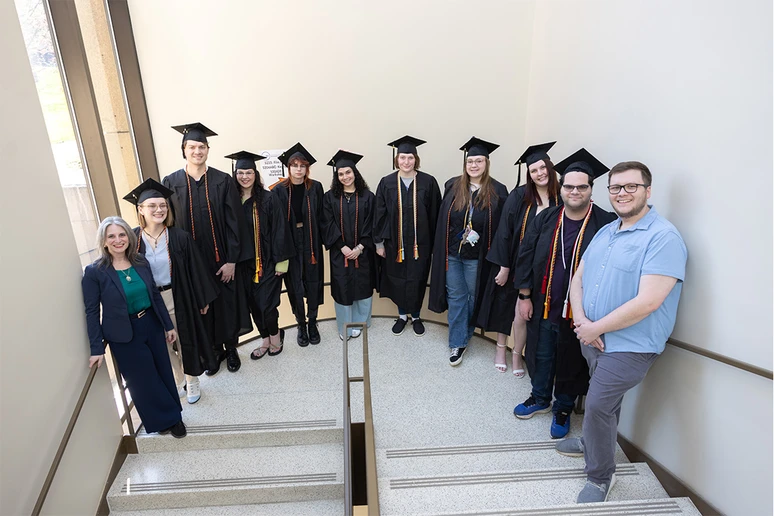
ACE Program Director Susan McGee (far left) with graduating students (left to right) Sarah Bliek, Nicholas Mruk, Lynn Patterson, Nikko Sandgren, Maya Monell, Alexandria Clemente, Hanna Bigelow, Emma Miller, and Matthew Rugg, and ACE Program Advisor Greg Swab. Missing from the photo is Matthew Schumacher.
SUNY Fredonia’s inaugural cohort of students in the Advancing Completion through Engagement (ACE) Program is approaching the finish line.
The 10 students who’ll receive undergraduate degrees in May overcame significant challenges that can easily sideline at-risk students from marginalized communities who often face barriers to achieving academic success.
But they’ve succeeded despite these odds; in fact, the program’s year-to-year retention and upcoming graduation rates exceed SUNY Fredonia's general student population. The ACE Program is clearly realizing its goal to enable students to be successful. This year’s ACE graduates transferred to SUNY Fredonia from community colleges, and many are also first-generation students in higher education.
“I am incredibly proud of the impact the ACE Program has already had on our students. After only two-and-a-half years, we are excited to witness our first graduating cohort,” said Dr. Susan McGee, who serves as ACE Program director.
“I am incredibly proud of the impact the ACE Program has already had on our students. After only two-and-a-half years, we are excited to witness our first graduating cohort.” said Dr. Susan McGee - ACE Program Director
The initial 34 students enrolled in the ACE Program at SUNY Fredonia in Spring 2024 semester have blossomed to 250 today. And their achievement numbers are indeed impressive: a 90 percent retention rate from Fall 2024 to Fall 2025. Over 60 percent of students have GPAs above 3.0.
ACE is a transformative SUNY-wide program that provides students with the support they need to complete their degrees. It helps cover textbook and other academic expenses, and provides academic assistance, personalized advising and career development activities.
Using a holistic approach, ACE Program advisors consider all aspects of a student’s college experience — academic, social and personal growth, Dr. McGee explained. “Our advisors help students clarify their goals, recognize their strengths and unique talents, navigate challenges and develop new skills that will serve them well beyond graduation,” she added.
“We act as the student’s secondary advisor, primarily focused on issues the student is facing outside of general course information, in the areas of time management, good study habits, helping them stay on track with the credits they do each semester,” explained ACE Program Advisor Gregory Swab.
“The last two semesters I’ve seen significant improvement in GPA, in their overall engagement in their college experience, going to workshops, asking questions when things go wrong,” Mr. Swab said. “They’re utilizing services on campus — tutoring, Disability Support Services, just becoming more involved than when I first started.”
“The Career Development Office [CDO] has been an especially important partner to the program. From their very first semester, students work with the CDO to develop professional skills, strong application materials and awareness of internship and career opportunities that set them up for long-term success,” McGee said.
Camille Epolito, an ACE Program advisor who works exclusively with first-year students, has enjoyed seeing ACE Program students getting accustomed to college life and diving further into their educational careers.
Students in the ACE Program come from varied backgrounds and all corners of the state, each with their own individual goals.
“The ACE Program has helped me in so many ways,” said Emma Miller, an Early Childhood/Childhood Education major with a concentration in Social Sciences, from Buffalo, NY.
“I always felt supported, and I knew if I ever had any questions I could reach out, and any member of ACE would be more than willing to help me. Not only did the ACE Program help me financially, but it prepared me to be successful after college!” Emma explained. Becoming an elementary school teacher and completing a graduate school program are her goals.
Nikko Sandgren, a first-generation student majoring in Psychology, with a minor in Women and Gender Studies, has built a supportive and productive relationship with ACE Program staff and students as well as with Career Development and Financial Aid offices, among other campus resources.
“The program has helped me gain more confidence in my studies and my future in psychology,” Nikko, of Rochester, NY, said.
Education and career goals of ACE Program students mirror those of their fellow students.
Working in the criminal justice system or attending graduate school are the leading options of Matt Schumaker, a Criminal Justice major, with a Sociology minor, from Westfield, NY, and Maya Monell, a Psychology major with a minor in Criminal Justice, from New York, NY.
Lynn M. Patterson, an Early Education/Childhood Education major, with a minor in Social Sciences, from Westfield, NY, wants to become an elementary school teacher.
Earning a master’s degree in Criminology from the State University at Buffalo and ultimately working for the FBI are goals of Hanna C. Bigelow, a Criminal Justice major, with minors in Psychology and Sociology, from Jamestown, NY.
Sarah Bliek, who will receive a B.F.A. in Theatrical Production and Design, from Rochester, NY, wants to work in local theater or with an independent set-up company.
Becoming an audio/visual production assistant is the career goal of Matt Rugg, a Communication: Audio Production major, with a minor in Computer Information Systems, from South Dayton, NY.
Nicholas Mruk, a Computer Science major from Angola, NY, wants to work in computer/internet technology in higher education.
Investigating careers in the mental health field before making graduate school plans is the first order of business for Alexandria Clemente, a Psychology major with a minor in Sociology. She’s looking forward to learning about the behavior technician field or entry level social work that deals with suicide prevention or working in the trauma-based field.
The ACE Program helped Alexandria improve her professional skills and ability to navigate situations as she transitioned to living on campus after attending Jamestown Community College.
Support from ACE Program advisors connected Alexandria, of Lakewood, NY, to a wide range of services the university provides, which in turn yielded an internship opportunity at a mental health clinic.
Swab, who has an M.S. in Higher Education and Student Affairs Administration, always wanted to work in a student support position, particularly with students from low-income backgrounds or marginalized communities. “I really wanted to work with that demographic, because I was one of them,” he said.
“I am grateful to be a part of that growing process and being a resource for them as they navigate obstacles and pursue their goals,” Ms. Epolito said.
“It is truly inspiring to see students’ confidence grow through the program,” McGee remarked. Many ACE Program students are now campus leaders — serving on executive boards, participating in student government and contributing to the campus newspaper, she said.
“Their success is a powerful testament to the strength of the ACE Program community and its mission.”