
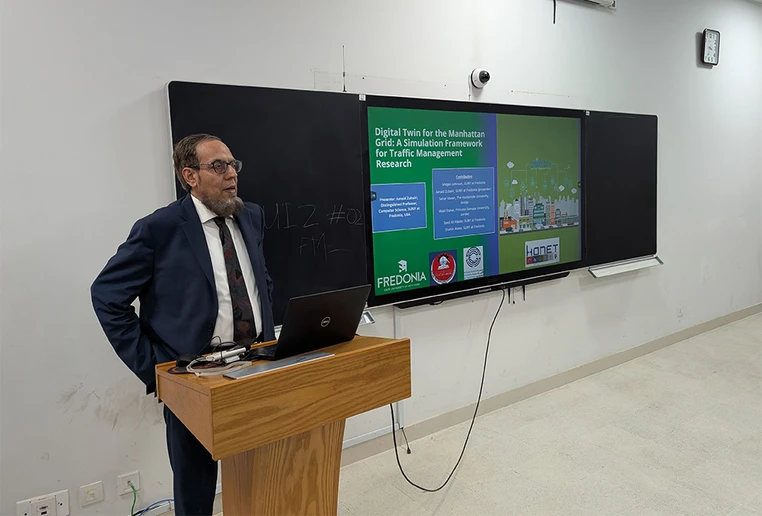
Dr. Junaid Zubairi, delivering his presentation at the 22nd IEEE HONET-ICT conference.
SUNY Distinguished Professor Junaid Zubairi presented an invited talk at the 22nd IEEE HONET-ICT conference held in Topi, Pakistan.
“Improving Quality of Life Using AI, Robotics and IoT” was the theme of the Institute of Electrical and Electronics Engineers (IEEE) conference, held Dec. 2 to 4.
In his presentation, Dr. Zubairi, who is chair of the Department of Computer and Information Sciences, summarized the work that is being done in the smart city research group at SUNY Fredonia. Contributors include Megan Johnson of the Department of Mathematical Sciences, Syed Haider and Shahin Mehdipour Ataee of the Department of Computer and Information Science, and Sahar Idwan and Wael Etaiwi, both of universities in Jordan.
"We have modeled the digital twin of a portion of Manhattan grid and implemented hierarchical routing, reactive congestion control and route planning for emergency vehicles for reduction in disaster response time.” - Dr. Junaid Zubairi
The smart city research group that Zubairi founded is working on traffic management in smart cities. The negative effects of traffic congestion in major cities include waste of fuel, waste of time and adverse effects on the temperament of drivers that can result in accidents.
A study estimates the public health costs of congestion across 83 U.S. cities to be nearly $43 billion.
“We have modeled the digital twin of a portion of Manhattan grid and implemented hierarchical routing, reactive congestion control and route planning for emergency vehicles for reduction in disaster response time,” Zubairi explained.
In this presentation, Zubairi discussed the simulation platform, configuration parameters and load effects on the grid. Also addressed were traffic management issues including multi-modal traffic integration, data fusion from heterogeneous sources and traffic capacity planning for future alterations and lane/road closures due to scheduled events or sudden mishaps.