
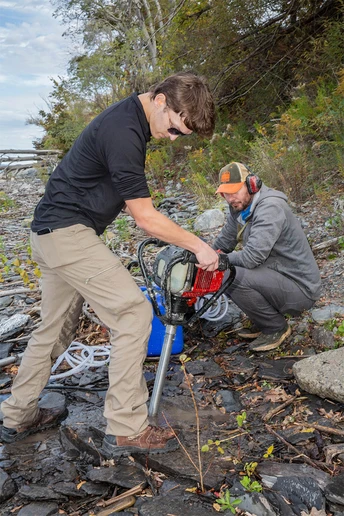
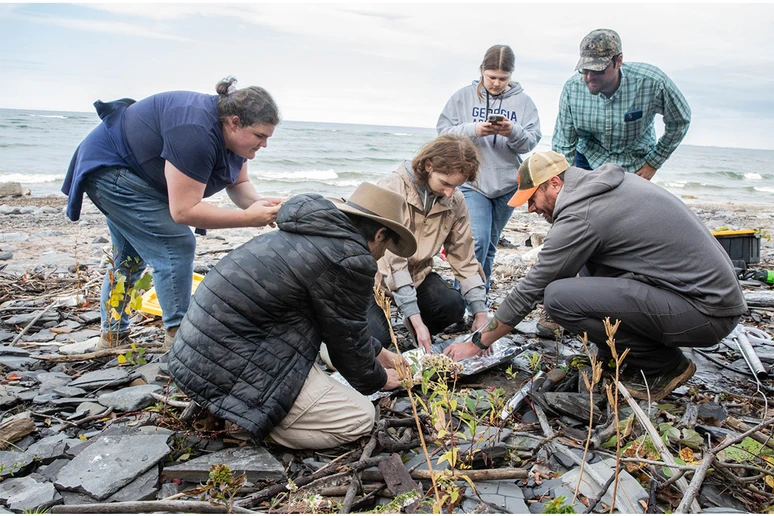
Randy Blood (far right) shows students how to properly wrap a core after it has been extracted.
Students gained “first-hand experience” burrowing through layers of black shale, guided by a highly skilled geologist and SUNY Fredonia alumnus.
Department of Geology and Environmental Sciences Associate Professor Thomas Hegna arranged the field trip with Randy Blood, a certified petroleum geologist and 2003 graduate, to Sturgeon Point, NY, where they drilled down more than six feet along the Lake Erie shoreline.
If our faculty are like the intellectual parents for our students, Randy is the cool uncle.” - Dr. Thomas Hegna
“My objective in taking these students out on these field trips is to give them first-hand experience of doing real science, collecting the data, looking at the rocks and putting it into something that can be presented at a meeting or maybe even published down the road,” Mr. Blood explained.
For nearly six hours on an usually warm day, students learned about “taking a core” — drilling through multiple layers of Upper Devonian Rhinestreet black shale and extracting samples for analysis.
“I wanted students involved in being able to actually operate the coring tool, so they are actually drilling and cutting through the core,” Blood said. They learned how to label and package the core, so it can be taken to a lab for analysis, he explained, “which are all techniques that are incredibly important when you’re doing this stuff out on a job.”
A key takeaway from the Sturgeon Point experience for Shaun Saunders was learning the unique geology of the site: that the black shale at Sturgeon Point has phosphatic layers that can give the shale a whitish color. The shale also contains fish fossils and plant fossils, the senior Geology major from Portville, NY, said.
“Although I’ve gone drilling with Randy a couple times before, this opportunity gives me great experience on how to run a core drill, how to wrap up the cores for safe shipping and also what we use the cores for,” added Saunders, who would like to work in the oil and gas industry.
Colin McKee, of Buffalo, NY, embraces “hands-on experience,” so the field trip was a great opportunity to acquire new skills, especially those that involve drilling equipment. “I also became more efficient at reading the local stratigraphy and viewing the rock record, thanks to Dr. Hegna and his mini tour of the Sturgeon Point outcrop,” the senior Geology major said.
For Samuel Post, gaining insight into what’s involved in taking a core was a key takeaway from the Sturgeon Point field trip.
“When you make a core, you can see what a section looks like far past what is exposed to the surface. This way you can understand what happened over a long period of time,” the sophomore Geology and Environmental Sciences major from Crane Ridge, NY, said.
Attending graduate school to prepare to become a paleontologist is a goal of Mr. Post, who’s always loved learning about the deep past and wants to advance his knowledge in that field.
For Blood, it’s all about sharing what he’s learned throughout his career and higher education with students.
“That was the opportunity that was offered to me when I was at SUNY Fredonia as a student and it really helped to launch my career and made me successful as a geologist, and I want to make sure that I can provide that opportunity to students today,” he said.
“If our faculty are like the intellectual parents for our students,” Dr. Hegna reflected, “Randy is the cool uncle.”
I wanted students involved in being able to actually operate the coring tool, so they are actually drilling and cutting through the core.”- Randy Blood
Two years ago, this “cool uncle” and Hegna took students on a field trip to Walnut Creek near Silver Creek, NY, to collect a 30-foot core of rock to help some German researchers understand circumstances that led to a major mass extinction event on earth hundreds of millions of years ago.
The Great Basin area in Utah will be the destination of another student field trip during spring break coordinated by Hegna and Blood. Day-long excursions in the area will provide opportunities for students to learn about the geology there up close and in person, Hegna said. So far, 18 students have signed up for the week-long excursion.
“Sturgeon Point was more about job experience,” Hegna said. “Utah will be all about broadening their horizons.”
Blood, who has a M.S. in Geology from the State University at Buffalo, is an AAPG certified petroleum geologist with extensive experience in petrophysics and has worked in the oil and gas industry since 2006. Before establishing his own firm, DRB Geological Consulting, in 2019, Blood was a senior geologist, chief geoscientist, petrophysicist and geologist with several Pennsylvania firms.