Undergraduates collaborate with faculty on published studies exploring the genetics and ecology of mantid reproduction.
Undergraduate students in the Department of Biology at SUNY Fredonia are co-authors on two newly published research papers examining the molecular ecology of praying mantids.
The studies grew out of collaborative projects in the laboratories of biology professors Dr. William Brown and Dr. Scott Ferguson, where six current and former Fredonia students contributed to research on the genetics and reproductive biology of the Chinese mantis (Tenodera sinensis).
Dr. Brown said that hands-on participation in research projects is a defining part of the biology program’s approach to undergraduate education.
“This project is a good example of the kind of work our undergraduate students can engage in at Fredonia,” Brown said. “At many institutions, this level of research involvement is reserved for graduate students. Here, our undergraduates are participating directly in meaningful scientific investigations and contributing to published research.”
Students involved in the project say the experience offered an opportunity to move beyond traditional classroom assignments and work with real scientific data.
“Collaboration is essential to producing good quality, novel research, and my time at Fredonia opened my eyes to what true collaboration can achieve,” said Sam Wilczynski, a Fredonia biology graduate who worked on the project. “With the help of Dr. Brown and Dr. Ferguson, we were able to bridge the gap between genetics and ecology to produce some first-of-its-kind research on Chinese mantids.”
Wilczynski said the interdisciplinary experience he gained through the project helped prepare him for his career after graduation.
“Thanks to the Brown Lab and the Ferguson Lab I was able to expand my skills in not one but two specialized fields,” Wilczynski said. “Our project on mantids combined genetics and ecology, and that experience helped me land a job as a wildlife biologist, where I use many of the skills I learned at Fredonia every day.”
Another former student researcher, Colm Roster, said the opportunity to contribute to publication-level work as an undergraduate set his experience apart.
“It’s pretty unique that Fredonia allows students to work on research projects like this in this capacity,” Roster said. “Being able to generate data that contributes to a publication as an undergraduate was a big step for me and not something that’s common at many institutions.”
Roster, who graduated in 2023 with a major in Molecular Genetics and is now pursuing graduate study at Clemson University, said the experience helped prepare him for the expectations of advanced research.
“Research is a field that really requires resilience and perseverance, and doing this kind of work as an undergraduate helped prepare me for that,” Roster said. “Fredonia gave me a strong foundation to move into graduate-level research.”
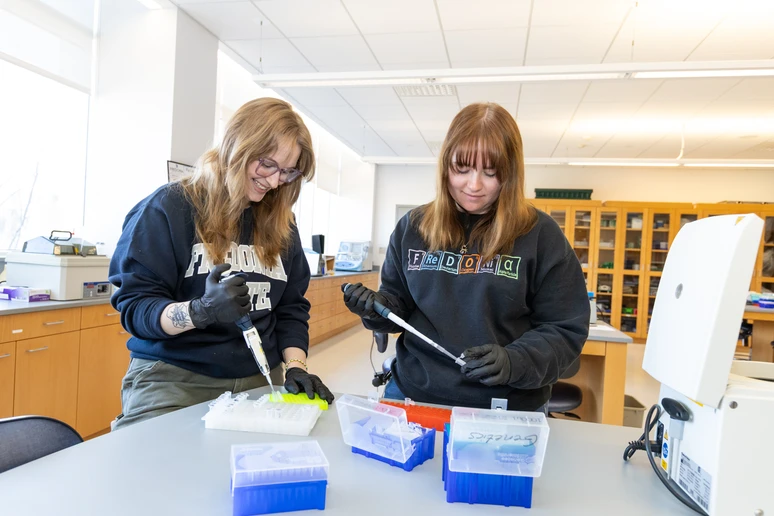
Dr. Ferguson said the collaboration grew from earlier student research and expanded as elements of the project were incorporated into the Molecular Genetics Laboratory, creating a course-based undergraduate research experience that allows students to contribute directly to the ongoing work.
“Projects like this give students experience that spans the full scope of modern biology,” Ferguson said. “They might be out in the field collecting mantids one day and in the lab analyzing DNA the next. That combination of molecular and ecological work helps prepare them for graduate programs and careers and positions them to be competitive for admission to the best graduate programs in the country.”
One of the newly published papers describes the development of genetic markers that allow researchers to examine parentage within mantid egg cases, or oothecae. Using these markers, the researchers documented evidence of multiple paternity in wild populations of the species, meaning offspring within a single egg case can have more than one father.
The research builds on a long-standing area of study in Brown’s laboratory, which has examined the behavior and reproductive strategies of praying mantids, including the evolutionary dynamics surrounding mating and sexual cannibalism.
Beyond the faculty collaboration, the studies reflect the role undergraduate researchers play in the department’s scientific work. Students assisted with laboratory experiments, genetic analyses and data interpretation throughout the projects.
Additional contributions came from students enrolled in BIOL 437: Molecular Genetics Laboratory, where portions of the data analysis were incorporated into a course-based undergraduate research experience. Rather than following a predetermined laboratory exercise, students in the course analyzed real genetic data connected to the ongoing mantid project.