
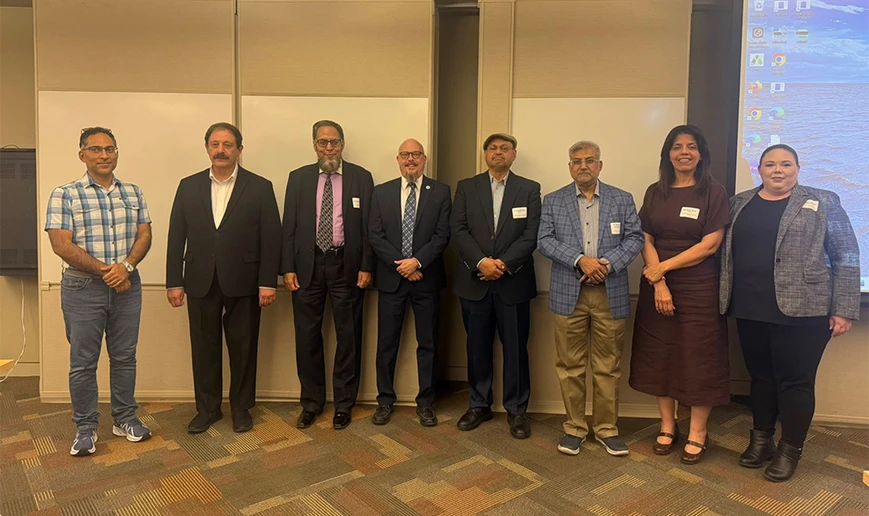
Participants in the Kraus Seminar on Smart City Research.
The Kraus Seminar on Smart City Research was held in SUNY Fredonia on April 27.
The program was sponsored by Kraus/Fredonia Conversations in Discipline Award established through the Fredonia College Foundation, and co-sponsored by the IEEE Buffalo Section.
The seminar was chaired by SUNY Distinguished Professor Junaid Zubairi from the Department of Computer and Information Sciences and co-chaired by Dr. Syed Haider, also of Computer and Information Sciences, and Dr. Megan Johnson of the Department of Mathematical Sciences. It was attended by the university administrators, IEEE Buffalo section representatives, Chautauqua County representatives, students and faculty members.
The program started with the introduction of the smart city research group in SUNY Fredonia. A snapshot of the work done by the group was presented by Dr. Zubairi, Dr. Haider and Dr. Johnson. The work is related to traffic management in an urban grid of a smart city. Dr. Zubairi explained the design of CONRES, a machine learning assisted algorithm for guidance of drivers for avoiding congestion. Dr. Haider presented the work related to accelerating emergency response through the automated control of traffic lights and Dr. Johnson talked about the use of SUMO (Simulation of Urban Mobility) system for studying the impact of lane closures and lane reversals on the flow of urban traffic.
The keynote by Dr. Jim Conrad of the University of North Carolina at Charlotte dwelt upon the design of an ATV (All-Terrain Vehicle) that can go off road in deep forests without the aid of GPS signals. The vehicle can be configured in “follow” mode in which the vehicle follows a walking person. Another keynote by Dr. Mohammad Shahidehpour of the Illinois Institute of Technology, Chicago, introduced the resilient networked microgrid he has designed for the IIT campus, saving the university close to $1 million per year on electric power expenses. Smart grids are an essential component of smart city infrastructure.
An invited presentation by Dr. Ahmed Khan of DeVry University, Chicago, examined the ethical dimensions of the use of AI in smart cities related to privacy, surveillance and bias. Unmanned aerial vehicles (UAV) are increasingly being used for various services in mega cities. Dr. Muhammad Jaseemuddin, an invited speaker from Toronto Metropolitan University, presented the networking and service delivery aspects of UAVs for smart city applications. Finally, Dr. Sahar Idwan, an invited speaker from Hashemite University in Jordan reviewed current solutions and emerging challenges in smart traffic management, drawing on a comprehensive survey of recent research.