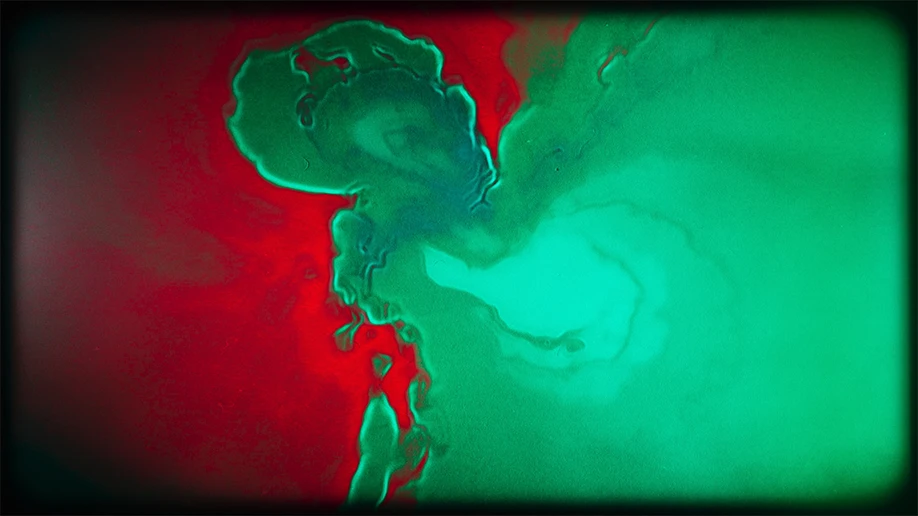
This still comes from Phil Hastings short, animated film “I Dreamed of Things Forbidden and Was Afraid.” Hastings, a professor of Film and Video, is one of nine members of the Visual Arts and New Media faculty taking part in the showcase.
Works by nine Visual Arts and New Media faculty will be displayed in the Marion Art Gallery beginning Jan. 27.
The gallery, located on the main level of Rockefeller Arts Center at SUNY Fredonia, will host the “Department of Visual Arts and New Media Faculty Showcase” through Feb. 15.
Participating artists are: Jason Dilworth (associate professor, Graphic Design), Tim Frerichs (SUNY Distinguished Professor, Foundations and Printmaking), Quintin Gleim (assistant professor, Animation and Illustration), Phil Hastings (professor, Film and Video), Tom Makovitch (studio safety supervisor and adjunct instructor), Abbey Paccia (assistant professor, Animation and Illustration), Hide Sadohara (associate professor, Ceramics), Peter Tucker (associate professor, Foundations Specialist) and Margaret Urban (associate professor, Graphic Design).
A reception from 6 to 9 p.m. on Friday, Jan. 30, will provide an opportunity to meet the artists. Both the reception and the exhibition are free and open to the public.
Gallery hours are Tuesday through Thursday from noon to 4 p.m., Friday and Saturday from noon to 6 p.m., Sunday from noon to 4 p.m., and by appointment. For more information or to schedule a group tour, contact Gallery Director Barbara Räcker via email at barbara.racker@fredonia.edu or call (716) 673-4897.
- Dilworth says of his work “Stationary Wanderings,” “This project continues my series of data-driven design artifacts. This project was inspired by my participation in the Binoculars to Binomials project with data artist Jer Thorp. Through his guided workshops, I deepened my birding practice, which shaped the direction of this work. Returning to clean typographic design, I created a set of postcards designed to foster community. The straightforward typography invites remixing and adornment — it isn’t too precious but instead reminds us of the shared cultural and natural history.”
- Frerichs writes, “The artist books and works on paper exhibited were created for my solo exhibition ‘Migration’ at the Vilnius Academy of Art, Gallery Akademija, Vilnius, Lithuania in October 2025. The works address the concept of migration through images and GPS mapping of the Lithuanian national bird, the White Stork. The White Stork annually migrates from Northern Europe to Africa, including South Africa. Elements of the GPS mapping are layered on archival digitally printed maps with images from Otto Lilienthal’s book “Der Vogelflug als Grundlage der Fliegekunst.” The works include handmade paper, paper-pulp painting, blowouts, etching monoprints, ink drawing, digital prints and commercial papers.”
- Gleim presents work from two series, “Blackbeard” and “Our Brilliant Ruin.” Originally created for the Mazza Museums Enchanted Brush-Legends exhibit, the Blackbeard series reimagines the myth of Edward Teach — better known as Blackbeard — by plunging viewers into the terror and disorientation his presence once inspired. Through a haze of smoke, dim light, and a deliberately compressed palette, the piece evokes the final moments of a doomed crew as an almost otherworldly figure emerges from shadow. By amplifying his most fearsome traits, the painting blurs the line between history and myth, portraying a pirate whose appearance was as formidable as his violence. Additionally, a series of chapter-plate illustrations created for the tabletop role-playing game “Our Brilliant Ruin.” These pieces portray the world’s three central factions: the Aristocrats, Truefolk and Unbonded.
- Hastings’ short, animated film, “I Dreamed of Things Forbidden and Was Afraid,” had its debut at the 2024 Hallwalls Contemporary Arts Center members show and then was screened at the Buffalo International Film Festival in October 2024. Hastings says this film is about the experience of living through a fog of uncertainty and the anxiety that comes from these experiences. “It is often only after we wake up and become conscious of our situation that we are able to diagnose or react to it,” he writes. The film has also been presented at the MicroActs Artist Film Screenings event in London, England.
- Makovitch’s entries “Ghost Bite” and “Shark Bite” represent the end of an experimental phase focused on challenging the limits of mold making as a primary process. Using materials like resin, plastic, and kozo, the act of casting and replication explores the hierarchies of value we impose on objects. This anew permanence transforms their silent narratives by redefining their sense of identity and place with color and form.
- In her digital animation titled “Spiral,” Paccia contemplates existential thoughts that slip through the margins of her days. The consideration of mollusk shells as containers of memory leads to the awe of small life and the connection of all beings.
- Sadohara writes of his terracotta relief triptych, “As I moved past the threshold of middle age, I assumed I had become desensitized to the realities of life. Instead, I find myself in a state of despair and confusion. We are living in an era of austerity — one in which everything feels uncertain, fleeting, and precarious. This new body of work is my attempt to articulate a liminal condition, navigating the interstitial spaces between joy and sorrow, past and future, precarity and stability, peace and conflict. It reveals the complex negotiations that occur at the thresholds of the human condition. These dualities shape our reality, leaving us suspended between moments of clarity and doubt. It feels as though we are forever balancing on the edge of two worlds, unsure which will ultimately determine our fate, yet still able to find an ethereal beauty in the act of navigating struggle in the process”
- Tucker explains his interest in the work of renowned Danish American woodworker, educator, and author Tage Frid (1915-2004), “I have wanted to make Frid’s three-legged stool for some time. I did not have experience or confidence with a number of the techniques needed to create the stool, but I have decided to start to build those skills. The cherry stool was made first as an exploratory piece. Danish furniture design would typically use a wood like cherry which allows the focus to be on the form itself. The copper beech stool was made second. The wood for this stool came from the copper beech tree that fell on campus in front of the Fenner House in 2024. The wood is much harder to work with and the intensity of the patterning in the wood distracts from the form itself. In addition to being an experiment in personal craftsmanship and growth, the two stools represent two very different approaches to object making — one in which the material itself becomes paramount and one which highlights the design.”
- Urban combines a designed book featuring her Ph.D. dissertation, “A Field Guide to the Anthro Silvan Interface,” with four digital prints that summarize key findings. Through an interdisciplinary examination of the relationship between humanity and trees or forests, the dissertation argues that this interaction provides a leverage point to affect a transformation in human behavior and mindset to create systemic change.
Funding for the exhibition and reception is provided by the Cathy and Jesse Marion Endowment Fund and Friends of Rockefeller Arts Center.