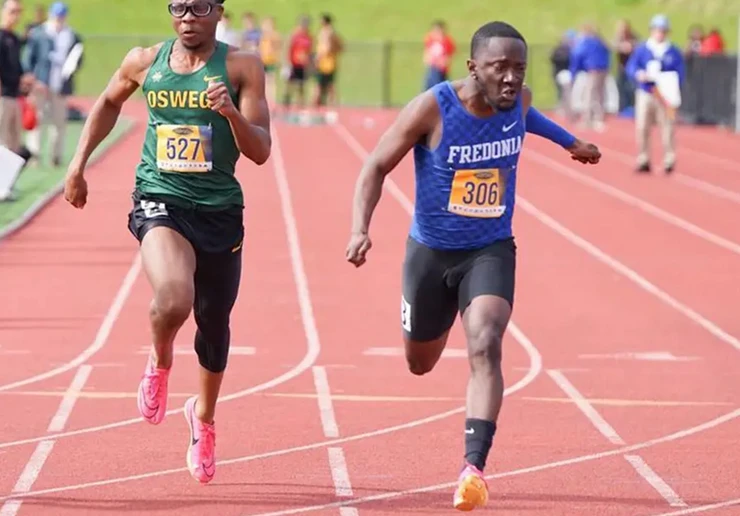
For most of his young life, Jacob Winn has been rewarded for speed. Growing up in Niagara Falls, NY, everything about him pointed forward, especially his passion for running. For sprinting.
“I spent my whole life trying to go as fast as I could,” he said. “And the most important thing I’ve had to learn since all this happened… was how to slow down.”
“All this” began one year ago this week, on an ordinary February afternoon at an indoor track meet, when a life built on speed suddenly, and literally, stopped.
41 Minutes
The bus ride from SUNY Fredonia to Nazareth University on Feb. 21, 2025, was uneventful. Jacob, a senior specializing in sprint events, woke up early, ate a protein bar (his usual pre-meet food) and packed his spikes. Everything still felt normal. At least, that’s what he told himself.
“I just felt… off,” Jacob recalled. “Not sick. Just off. Like my body felt heavy. Like I was running with a weighted vest on.”
Jacob’s pre-meet nerves felt strange too. He dismissed it, joked with teammates, went through handshakes, and joined the team jog around the track. Jacob spotted his coach, Fredonia Assistant Track and Field Coach Nick Abdo. Now in his third year of coaching, Abdo was Winn’s teammate at Fredonia when Abdo was a senior and Winn was a freshman. Jacob gave him a nod and moved toward the sprint area. He slipped into warm-up mode, pushing through a few light accelerations.
“That’s my last memory,” he said. “Doing warm-ups.”
He never felt himself fall.
Jacob collapsed on the track in full view of teammates, coaches, and competitors. There was no dramatic buildup, no visible warning.
Jacob’s teammate screamed for Abdo. His coach and friend momentarily thought Winn was joking about a minor injury.
“When I got there, he wasn't moving anymore,” Abdo said. “I looked down at him, and his eyes were facing backwards. And I just remembered yelling. After that, it felt like a dream. I kept thinking, ‘this is not happening.’”
Jacob had gone into cardiac arrest. Trainers rushed in. CPR began within 90 seconds. An AED was brought out. EMTs arrived and took over. Jacob was shocked by the AED, then shocked again. Each time, his body responded, then slipped back.
It took 41 agonizing minutes, including non-stop CPR compressions and several more AED shocks, before Jacob was stable enough to be loaded onto a stretcher and rushed out of the building. His stunned teammates watched it all unfold in front of them. “I had to try to calm them down, so I walked over and told them what I truly believed, that Jake was good," Abdo recalled. "That he had a heartbeat, that it was precautionary. I wasn’t going to go in there and tell them we didn’t know if he was going to make it.” Fredonia’s coaches and staff eventually made the decision to leave the meet, and the team rode a silent bus back to the Fredonia campus.
Meanwhile, Jacob had been rushed to Strong Memorial Hospital in Rochester, not far from the Nazareth campus. By the time he arrived, his heart was unstable, his lungs were failing, and his kidneys would soon follow. Doctors induced a coma, surrounding him with machines that breathed for him, filtered his blood, and forced his body to keep going.
“I had no idea what my body had been through,” Jacob said. “I didn’t know my kidneys failed. I didn’t know my lungs were failing. I didn’t know any of it.”
But while Jacob was unconscious, others lived every minute.
Back at Fredonia, Moshawn Baird, Jacob’s girlfriend, was finishing a shift at work when she noticed something odd on social media; a vague post that included a prayer emoji, but nothing that caused immediate alarm.
“I thought maybe he hurt his ankle,” she said. “I really didn’t think much of it.” Then her phone rang. “Someone told me Jacob had a cardiac arrest, and I was stunned,” she said. “I didn’t even know how to process that.”
She called his family, then her own. Soon after, she was on the road to Rochester, arriving late that night to sit in a hospital waiting room with Jacob’s parents, brother, and uncle.
Doctors told them the next 48 hours would be critical. Jacob lay unconscious, tubes running in and out of him. His body still responded faintly to voices Jacob would not remember. His parents, his relatives, and those closest to him, including Moshawn and Nick, held vigil.
For days, machines kept him alive while everyone else wondered when, or if, he would wake up. According to the American Heart Association, approximately 350,000 people in the U.S. experience an out-of-hospital cardiac arrest each year. Ninety percent result in death. For those who survive, recovery can be complex.
“My biggest fear was that Jake wouldn’t be Jake anymore,” Abdo said. “I was worried about oxygen loss. I was worried he’d wake up and not be himself.”
No one would know the outcome for several agonizing days.
Where did the days go?
Jacob’s sedation was reduced. His body stirred. “I remember hearing beeping,” Jacob said. “That’s the first thing.”
He opened his eyes. The room was unfamiliar. The steady, mechanical rhythm of machines he couldn’t see. He turned his head slightly and caught a glimpse of someone sitting nearby. It was his father.
“I didn’t know where I was,” Jacob said. “I was just confused.”
He tried to speak, but his voice was weak. “Dad,” he said. “Where am I?” His father told him he was in the hospital. Jacob processed that for a moment, then asked a question that would become painfully repetitive in the weeks to come. “When can I go home?”
Jacob glanced around the room again, his eyes landing on a whiteboard mounted on the wall, where nurses wrote the date and time in dry erase marker.
March 2, 2025.
“I thought it was February,” Jacob said. “I thought maybe I’d been out for a night. Maybe a day.” He did the math in his head. Then he stopped trying. “I just remember thinking, ‘I blinked, and all this time passed.’” His father tried to explain what had happened. The collapse; the cardiac arrest; the coma. Jacob struggled to absorb it.
When a nurse entered the room, Jacob asked her the same thing. “When can I go home?” This time, the answer was clearer. “There’s no release date,” she told him. That was the moment reality set in. Jacob asked where his mother was, where Moshawn was. He asked about the meet. Did he run well? Did he PR? How did the team do? No one answered those questions directly. “I kept asking about track,” he said. “That’s all I knew.”
As the hours passed, confusion gave way to fear. Fear turned into frustration. Frustration began to settle into something heavier. Jacob Winn had spent his life measuring progress in seconds. Now, progress would be measured in breaths, steps, and moments. But also in days, weeks, and likely, months.
The aftermath and the struggle
The days after Jacob Winn woke up did not feel like survival; they felt like confinement.
Once the initial relief wore off, that he was awake and could speak, that his brain still worked, Jacob’s first questions remained unanswered: “When can I go home? What happened to me? What comes next?”
“I thought once I woke up, I’d be out of there in a day or two,” he said. “That’s how hospitals work, right? You wake up, you go home.”
That wasn’t how this situation worked. The physical damage was extensive. His kidneys had shut down and would not immediately restart. His lungs were fragile. His heart was capable of stopping without warning, and no one knew why. Jacob started dialysis, then physical therapy, then occupational therapy. Each came with its own list of limitations.
But it was the mental toll that hit him hardest. “I lost myself,” Jacob said. “Completely.”
For the first time in his life, his body did not respond to what his mind demanded. He could not stand on his own. He could not walk without help. He could not brush his teeth or shower without someone nearby.
“I’d never been dependent on anybody like that,” he said. “Ever.”
Worse still was the growing realization that running might be over. Doctors did not sugarcoat it. “They told me, straight up, ‘You might never run again,’” Jacob said. “That’s all I knew,” he said. “Track. Sports. Competing.”
Days blurred together. Jacob began turning visitors away. Coaches, friends, teammates, and even family members. “It wasn’t helping me,” he said. “They’d come in, and then they’d leave. And I was still stuck there.”
Watching people return to normal life, like classes, practices, and routines, made the isolation sharper. Jacob asked for a smaller hospital room, one that could only hold a nurse and one visitor at a time. He wanted quiet. He wanted space. He wanted control over something.
“I had thoughts of harming myself,” he said quietly. “I didn’t know who I was anymore.”
Nurses noticed the change. Doctors noted it in his chart. Eventually, a psychiatrist was brought in to help. “She asked me what I liked to do besides sports,” Jacob said. “I didn’t have an answer.” Reading? Drawing? Music? None of it resonated. Those were distractions. Track had been his identity.
What helped were the people who knew that identity intimately. His father sat with him for hours, sometimes without speaking. A former boxer whose own career had ended abruptly, Jacob Winn Sr. understood the grief of having your body betray you. “He knew what I was going through before I even knew how to explain it,” Jacob said.
Together, they practiced the basics. Standing, walking, and climbing stairs. Each small success felt monumental and humiliating all at once. “There were days I didn’t want to try,” Jacob admitted. “And he’d still be there.”
Moshawn was there, too. She made long drives after classes or after work. Sometimes Jacob pushed her away. Sometimes he snapped. Sometimes he told her not to come back. She did anyway. “She never changed,” he said. “No matter how bad my attitude was.”
“Seeing someone so strong, so young, go from being completely independent to fighting just to get through the day really changed how I look at everything,” Moshawn said. “It made me realize how quickly life can change, and how important it is to not take people, or time, for granted.”
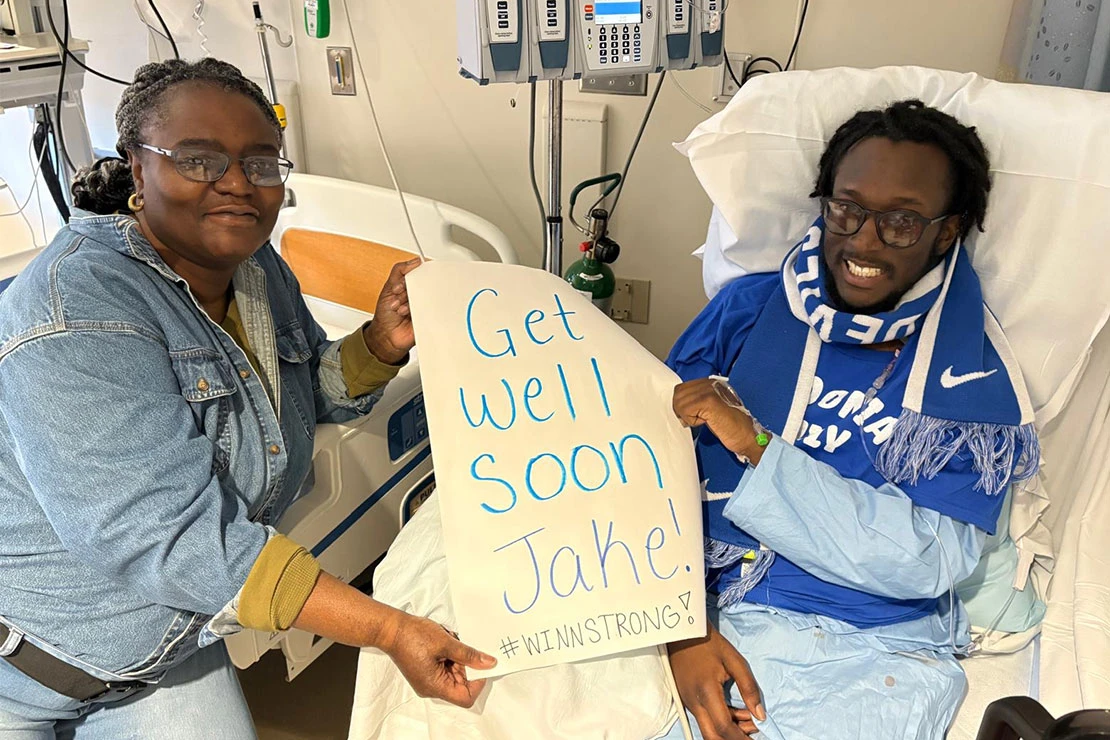
One afternoon, not long after Jacob was moved out of the ICU, someone else walked through the door. It was SUNY Fredonia’s Vice President for Student Affairs Tracy Stenger. Jacob remembers Dr. Stenger’s long white coat and the bags she carried.
Even though she had previously visited the hospital while he was unconscious, Jacob had never met her before. “She walked in smiling,” he said. “And something about that just… changed the room.” Dr. Stenger brought gifts, cards, and messages from across campus. They came from coaches, faculty, and even students he had never spoken to.
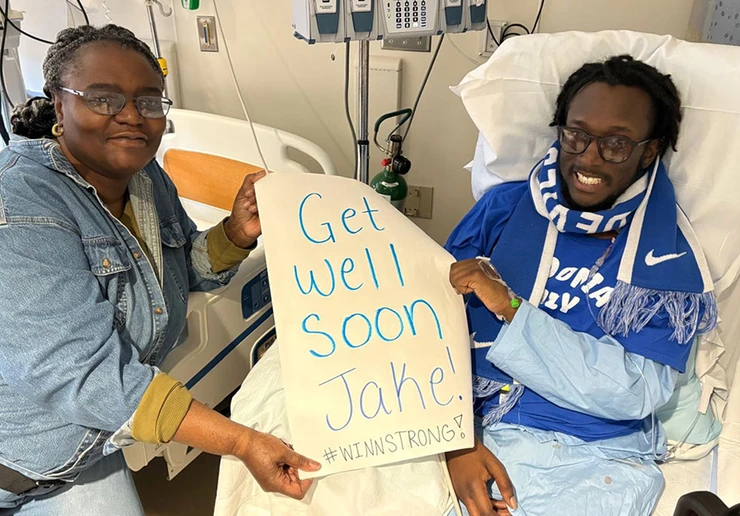
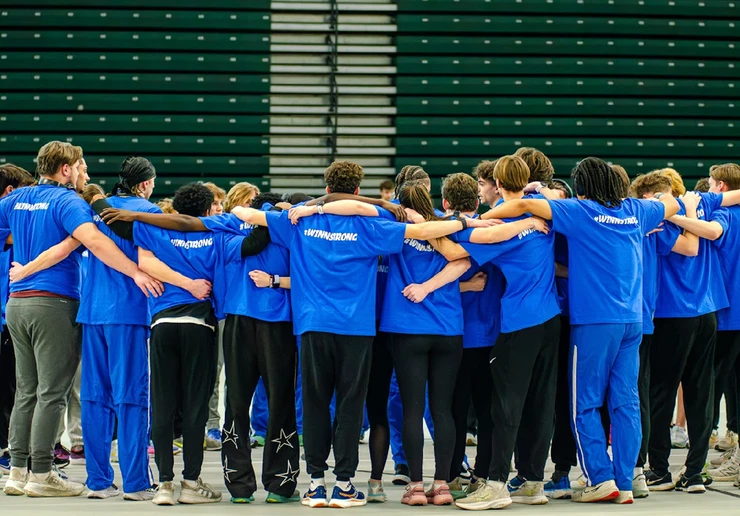
“We purchased a Fredonia scarf for him,” Dr. Stenger said. “The Athletics Department made a t-shirt with '#WinnStrong' on the back. We had a poster that his teammates had all signed and had written messages on. And there were many cards and other well wishes for him too.”
Jacob sat quietly, opening each one. “I didn’t know the school was rooting for me,” he said. “I didn’t know people I’d never met cared.”
“He kept talking about walking to the next exit sign,” Dr. Stenger said. “Here’s this sprinter who used to fly down the track, and now his goal was just the next exit sign in the hallway. But that’s how he approached it; one small goal at a time.”
They talked for hours. Topics included school, graduation, and life after the hospital. “She never talked about the coma,” Jacob said. “She talked about my future. That mattered.”
Another moment that mattered came a few days later when coach, and friend, Nick Abdo came back. He arrived extra early that day, long before visiting hours started, and stayed all day. Together they filled out NCAA basketball brackets, argued over picks, and watched the games. “For the first time, I wasn’t thinking about the hospital,” Jacob said. “I was just… watching basketball.”
“I started realizing I wasn’t as alone as I thought,” he said.
Jacob had begun to understand something he had never been taught on the track; recovery was not a sprint. It wasn’t even a race. It was endurance. “I had to learn how to live one hour at a time,” he said. “Not one day. One hour.” For someone who had spent his life chasing speed, it was an unfamiliar rhythm.
The hospital stay stretched on. There were setbacks. One was particularly terrifying. Jacob’s body temperature dropped rapidly during a dialysis session, triggering alarms. "I couldn’t move. I couldn’t talk,” Jacob said. “I was frozen.” Nurses wrapped him in heated blankets and stayed with him until his temperature rose again. One held him steady, repeating a single instruction.
“Stay with me.”
That episode ended his dialysis entirely. His kidneys finally began to recover on their own.
A fateful decision
By late March, about the time he was deciding what team to advance on his March Madness brackets, Jacob had to make a much more difficult decision.
Doctors came into his room together; a sign Jacob had learned to read. “They started talking about an ICD,” he said. “And I had no idea what that was.”
An implantable cardioverter defibrillator is a device that would monitor his heart and shock it back into rhythm if it stopped again. The explanation was clinical. The implication was not.
Without it, there were no guarantees. “I didn’t want anything in my body,” Jacob said. “I just wanted to go home.” His mother had already made the decision. It was one of the many difficult conversations she had with doctors while Jacob was in his coma. She had listened to every option, weighed every risk, and landed firmly on this one. When Jacob resisted, she was direct. “The faster you do this, the sooner you can go home,” she said.
That landed. If mom believed this was the right decision, he believed it too. “I didn’t want it,” he said. “But I trusted her.”
When Jacob woke up following the ICD surgery, the device felt heavy, unfamiliar, and was a constant reminder of how close he had come to a different fate. “I didn’t want it,” he said. “But it saved my life before I even wanted it to.”
Rehabilitation resumed, with simple tasks like walking, climbing stairs, and learning how to move again. Finally, doctors returned with words Jacob had waited more than a month to hear: a release date.
“At first they said Friday,” he said. “Then Monday. I didn’t care. I just needed a day.” On March 24, 32 days after collapsing on a track at Nazareth, Jacob Winn was discharged from the hospital.
Doctors filled the room with paperwork. Jacob signed nothing. He handed everything to his mother. “I was ready,” he said. Nurses hugged him. Some brought small gifts; simple gestures reserved for patients who had beaten improbable odds.
He left the hospital in a wheelchair. When he stepped outside, his mother handed him a larger gift; keys to a new car. “She said this was a bigger milestone than graduation,” Jacob said.
A new normal
When he left the hospital, Jacob Winn believed the hardest part was behind him. He survived and was no longer tethered to machines or IV poles. That was supposed to feel like freedom.
“I didn’t really have anything to do,” Jacob said. “And I wasn’t used to that.”
Classes were still happening without him. Practices went on. Friends followed schedules he no longer shared. Jacob, once defined by a tightly packed daily routine, found himself with hours to fill and nowhere to put them. “It was boring,” he said. “But it was also… lonely.”
He had withdrawn from Fredonia for the spring semester on medical leave. His name was still on the track roster, but he was no longer living like a student-athlete. At first, he stayed home. Then one afternoon, he made a decision. “I told my dad I wanted to surprise Fredonia,” Jacob said.
When Jacob walked into the indoor track facility, practice was already underway. His father entered first. Then Jacob followed a few steps behind. The room went quiet. “It felt like I won the Super Bowl,” Jacob said.
Teammates rushed toward him. There were careful hugs, laughter, and a few tears. It was the first time many of them had seen him in person since the collapse. Jacob moved slowly, still fragile, but smiling in a way he hadn’t in weeks. “It felt like home,” he said. That feeling stayed with him. So did the realization that Fredonia hadn’t moved on without him.
That realization was reinforced in May when the SUNY Fredonia Athletics Department gathered for the “Freddy’s,” the annual year-end athletics award ceremony. Jacob didn’t want to go. Emotionally, he wasn’t ready. He hadn’t finished the season. He didn’t feel like he belonged in a room celebrating accomplishments he hadn’t been able to complete. But his coaches insisted. “They told me I had to be there,” he said. “That people wanted to see me.”
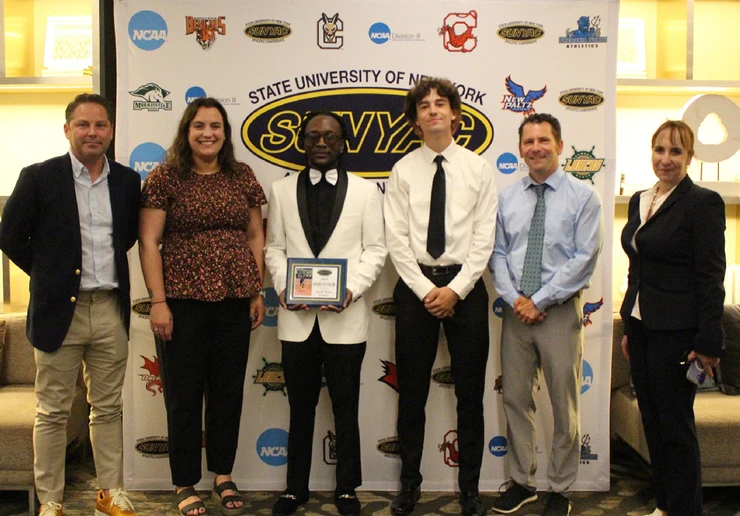
During the ceremony, Jacob sat quietly as awards were handed out. Then, near the end of the program, one award remained. The Blue Devil Belief Award. The recipient: Jacob Winn.
As he stood and walked to the stage, the room rose with him. The applause was longer and louder than he expected. He listened as his journey was shared with the audience, still unsure how to process it. “It felt unreal,” he said. “Like that award belonged to more people than just me.”
“For the first time since the hospital,” Jacob said, “I didn’t feel alone.”
Later in the spring the SUNY Athletic Conference (SUNYAC) awarded Jacob the SUNYAC Award of Valor.
A jolt of reality
Summer arrived. Jacob stayed home, rested, and tried to enjoy the quiet. His body continued to heal. His medications stabilized. Life began to resemble something close to normal.
Then, in July, his heart reminded him that it wasn’t finished. One night, Jacob felt off again. His heart raced dangerously fast. His parents rushed him to the hospital. In the emergency room, his heart rhythm spiked. For a moment, it stopped.
His ICD fired.
The shock brought him back.
“If I didn’t have that device,” Jacob said, “that would have been another cardiac arrest.”
This hospital stay was shorter this time — just three days — but the impact lingered. Doctors adjusted his medications. Then they ordered genetic testing. The results arrived weeks later. Arrhythmogenic right ventricular cardiomyopathy (ARVC), a genetic heart condition. It’s rare, often undetected, and potentially fatal. For Jacob, it explained everything.
“It was scary,” he said. “But it also gave answers.”
With those answers, a new concrete medical strategy was developed, including the ICD, the medications, and the monitoring. All of it was working. So, Jacob made another decision. He would return to Fredonia. In the Fall 2025 semester, he took over 20 credits. Now, in the Spring 2026 semester, he’s taking even more. “I had to finish,” he said.
Time management, once an afterthought, became essential. Jacob planned everything: classes, rest, and medication schedules. Other things changed within him, too. “I learned how to talk to somebody; to actually sit down and discuss how I feel mentally,” he said. He learned how to ask for help. How to talk openly. How to slow himself down before his body forced him to. He wasn’t the same person who collapsed on the track. “I grew up,” he said. “A lot.”
He began thinking about the future differently, too. While he’s on track to complete his degree in Sport Management this spring, his career goals have shifted. He now aspires to become the sports psychiatrist he never had; someone who could help athletes process trauma and loss. “I know what it feels like to lose your identity,” he said. “And not know who to talk to.” Jacob also began imagining ways to give back. He wants to host a track meet, has raised money for cardiac care, and has mentored young athletes who hadn’t yet seen a future beyond speed.
One year later, Jacob Winn still thinks about the track. He still misses it. He knows he cannot race again. But he no longer defines himself by how fast he can go. “I used to race everything,” he said. “Now I just try to be present.”
Exactly one year ago, his life stopped without warning. Today, it moves forward, deliberately. Towards that next exit sign.
And for the first time, that pace feels right.